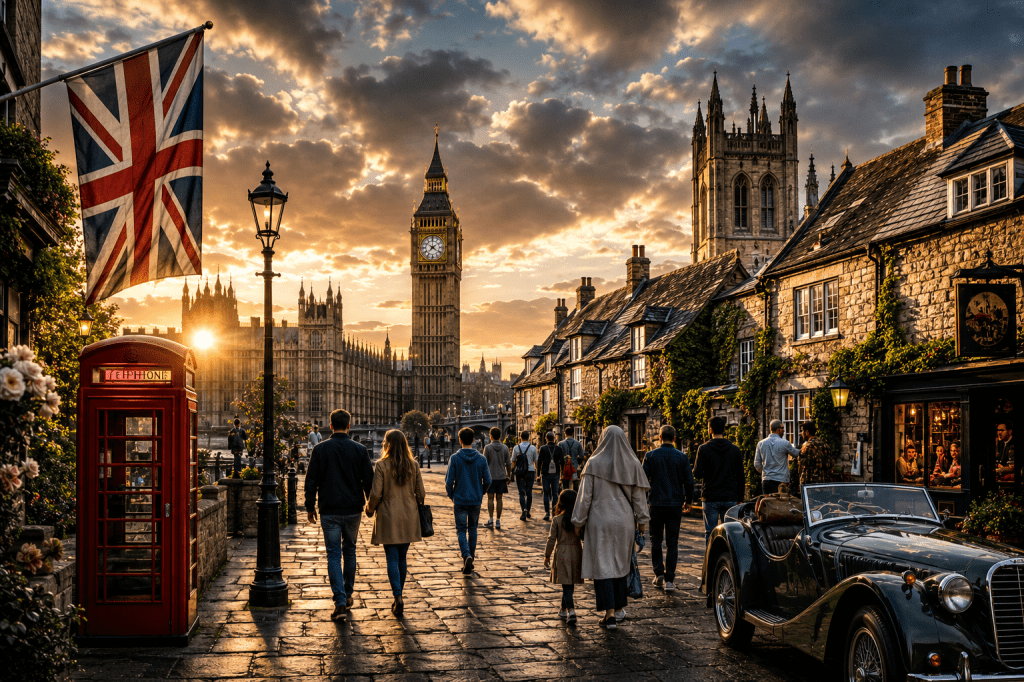
Britain’s Greatest Export Was Never Tea

By a guy who wasn’t born British, chose Britain anyway, and fell in love with it enough to worry about what happens next.

People often say Britain’s greatest export was the English language.

Nonsense.

Its greatest export was Britain itself.

Not the island. Not the government. Not even the endless supply of television detectives who seem capable of solving six murders before lunch.

What Britain exported was an idea.

The idea that strangers could live together under a common set of rules. That a queue mattered. That fairness mattered. That people should be left alone to get on with their lives. That a promise meant something. That institutions, however imperfect, deserved respect.

These things sound dull.

They’re not.

They’re the reason Britain became one of the most successful societies the world has ever seen.

Take a walk through almost any English village and you’ll see it. A church that’s older than most countries. A pub that’s survived wars, recessions, and generations of people convinced avocado belongs on everything. A cricket green. A railway station. A high street.

None of these things happened by accident.

They are the product of a culture that evolved over centuries.

And here’s the uncomfortable bit.

A culture is not a museum piece. It survives only if people value it enough to keep it alive.

Britain has always changed. That’s normal. Every successful country changes. New ideas arrive. New foods arrive. New people arrive.

Most of the time, that’s a good thing.

The best newcomers don’t weaken a country.

They strengthen it.

They adopt what works, contribute their own talents, and become part of the national story.

But there is another model.

A model where people arrive and immediately begin insisting that the host society should become more like the place they left behind.

And that makes absolutely no sense.

If Britain was good enough to move to, surely some of the things that made Britain attractive in the first place are worth preserving.

This isn’t about race.

It isn’t about nationality.

And it certainly isn’t about whether someone was born in Birmingham, Bucharest, or Bangladesh.

It’s about something much simpler.

Do you wish to become part of the place you’ve chosen to call home?

Or do you wish to remake it into something else?

Because those are very different things.

A successful society depends on a shared understanding of how life works. Trust. Respect. Personal responsibility. Tolerance. Civic pride.

When enough people stop sharing those assumptions, cracks begin to appear.

Not dramatic cracks.

Small ones.

A little less trust.

A little less cohesion.

A little less sense that everyone is pulling in the same direction.

And eventually people begin to feel like strangers in places that once felt familiar.

This isn’t just a British question.

Much of Western Europe is wrestling with exactly the same issue.

How do you remain open without losing yourself?

How do you welcome newcomers while preserving the culture that made people want to come in the first place?

The answer cannot be to pretend culture doesn’t matter.

Of course it matters.

Culture determines whether people trust each other. Whether they obey the law. Whether they feel connected to their neighbours. Whether communities flourish.

A nation is more than an economy.

It’s more than a collection of postcodes.

It’s a shared story.

And every generation becomes responsible for deciding whether that story continues.

Perhaps there is a lesson here for the rest of the world.

If you’re seeking a new home, don’t merely ask where the salaries are highest.

Ask where your values fit.

Ask where you can genuinely belong.

Ask where you can contribute rather than collide.

Because the happiest migrations are not those where one side wins and the other loses.

They are the ones where newcomers embrace the best parts of their adopted home while adding something positive of their own. I should know. I was a British immigrant myself. And I’m still proud to be British!

Britain remains one of the most remarkable countries on Earth.

Not because it’s perfect.

Anyone who has sat on the M25 or tried to get a GP appointment knows that isn’t true.

But because it created something rare.

A society built on trust, civility, continuity, and a quiet belief that tomorrow should be a little better than today.

That is a precious thing.

And precious things are worth protecting.


Thanks for dropping by my little corner of the world. If the story gave you a chuckle or made you pause and think, a like would be mighty kind. And if you’re feeling adventurous, well, hitting that subscribe button is like pulling up a chair and staying a while—always room for one more.

I subscribe back, by the way. It’s my way of saying, “Welcome to the club—snacks are in the back, good times up front!”


Your comments make me smile, sometimes laugh out loud, and every now and then, they nudge me to dig a little deeper, write a little better. So, stick around—who knows what we’ll stumble upon next!


My book, Hidden Alignment is still available on Amazon in paperback and Kindle for those interested. Link and QR code below.

Link: https://a.co/d/0enjFI6f

24 responses to “Britain’s Greatest Export Was Never Tea”

  1. Sarada Gray Avatar
    Sarada Gray

    Can’t disagree with what you say, but I’m not sure Brits abroad take that attitude. A lot of them seem keen on recreating the Britain of the 1950s wherever they happen to be, like Robinson Crusoe

    Liked by 3 people

    1. AKings Avatar

      And I think, that isn’t a bad thing ☺️. Like what I said, sharing culture that enriches the other culture. ☺️. I might be biased though Sarada ☺️.

      Like

      1. Sarada Gray Avatar
        Sarada Gray

        Hmm. Certainly as regards places like Spain rather than enriching the culture they seem to huddle in enclaves and just patronise English shops and bars, all while not learning a word of Spanish

        Liked by 4 people

      2. AKings Avatar

        Now that is not good. Spanish isn’t too hard to learn too. ☺️

        Like

      3. Sarada Gray Avatar
        Sarada Gray

        Es verdad

        Liked by 1 person

      4. AKings Avatar

        Siempre ☺️.

        Like

    2. Janner Boy Avatar

      that is very true, especially in Spain, the irony is that most of them voted to leave the EU and were quite miffed that the Spanish revoked their rights to stay indefinitely!

      Liked by 3 people

      1. AKings Avatar

        Spaniards, who needs them, eh? 😂

        Like

  2. Joey Jones Avatar
    Joey Jones

    Great post! Rule Britania! 😆

    Liked by 2 people

    1. AKings Avatar

      Britannia rules the waves!

      Liked by 1 person

  3. Janner Boy Avatar

    Really well thought through article, and very timely on the 10th anniversary of the Brexit vote that did more to confuse us than more than anything else in our recent history.

    It has spawned a politics where all parties claim to hold to the values, but as their views are so opposite most people have lost their grip on what our values really are.

    Don’t forget the cricket greens become football pitches in the winter – we are very adaptable.

    Liked by 1 person

    1. AKings Avatar

      I fell asleep 2X whilst watching a cricket match in Portsmouth. The game just never ends! 😅

      Liked by 1 person

  4. Klausbernd Avatar

    We have lived in England since the 80s, in an idyllic village by the sea. We moved there from New York City because the US was too American for us. To get integrated in the UK, you have to do some voluntary work in your place. There are many different groups which will welcome you.
    Actually, we are German and Norwegian. It was much easier for us to get integrated into an English village than into a German one. We love that you can be eccentric here; it’s expected to be at least a bit eccentric.
    The Fab Four of Cley
    🙂 🙂 🙂 🙂

    Liked by 2 people

    1. AKings Avatar

      Thanks Klaus!

      Liked by 1 person

    2. Helen Devries Avatar
      Helen Devries

      Is NFN a thing of the past now the Chelsea Tractor set have moved in?

      Liked by 1 person

  5. Bronlima Avatar

    Yes, you ha e tk love the country you move to. Peru, like all counties has its problems but ha a beautiful soul. I confess, i still bring my teabags and Marmite, but celebrate the spirit of this different culture which I have enjoyed and appreciated for forty years. Viva el Peru, carajo!

    Liked by 1 person

    1. AKings Avatar

      Well, English tea and Marmite, that’s the very definition of adding a positive to your new country. ☺️

      Liked by 1 person

  6. Madeline Bialecki Avatar

    I love Britain and have visited there 5-7 times (with plans to go next year). But, I recently spent 6 weeks in Central Europe–my first time in16 years–and the drunken Brits in places like Prague and Krakow are worse than I remember (and I do remember them from 16 years ago). They come for a weekend, start drinking in the morning and by late afternoon are drunk. Many become loud and rowdy. Some become rude and lewd. I have never seen Brits behave so badly in Britain. They are a disgrace their homeland and people.

    Liked by 1 person

    1. Helen Devries Avatar
      Helen Devries

      Try the rugby crowd after Twickenham…..

      Liked by 1 person

      1. AKings Avatar

        I was from Liphook a village North of Portsmouth. I’ve seen a Portsmouth VS Southampton match in the early 2000s. Now that was a proper football match 🤕😅🤣.

        Liked by 1 person

    2. AKings Avatar

      That’s true. And I have to admit that there was a time in my youth that I have never seen Prague in the daylight. It was always in the nighttime. Brits, male and female become rowdy coz they think they’re allowed there and that it’s welcome there. Well it’s not and it really is disgraceful.

      Like

  7. David Avatar

    You have some very interesting thoughts there. I am a born and bred Kiwi (from New Zealand / Aotearoa) as is my mother, although my father came over from England after WW2 and my maternal grandparents came from England after WW1. So I have English roots and grew up in a country that was very English (or Scottish in Dunedin).

    But of course Aotearoa is also home to the Māori, who migrated here about 600-800 years ago and had a thriving, non-mechanical culture when westerners arrived. Initially there was a lot of typical western colonialism and land grabbing and repression of the Māori cultural identity. There was also a significant drift of younger Māori to the developing cities with their English culture and perceived opportunities.

    By the time I was growing up in the 60s and early 70s government policies had made mainstream NZ was very much western with Māori culture mainly based on the rural towns and communities. Then everything started to shift. Māori identity and culture started to gain more presence in political circles and that trend has continued until today, with Māori language and culture now legally as equally valid as English language and culture. Coupled with a significant immigration from Asian and many other places of the last 25 years, we are now a very multicultural environment.

    Personally I feel this is a good thing – as well as Christmas we also have Chinese New Year, Diwali and Matariki (the Māori mid-winter celebration) and many other religion-based celebrations from many different religions, and we are slowly starting to merge English and Māori cultures which is bringing some humanity and caring to off-set the western (American) consumerism and corporate greed culture being absorbed through the very American-sourced entertainment industry.

    However, an interesting side-effect I am seeing at the moment is the gap being left by the active community and workplace support for any non-mainstream group . At my government workplace we had social groups for people who were into chess, board games etc, Māori cultural performance and other “open to all” activities, and there were groups for Maori, Chinese, and Indian communities, members of various religions, and also groups for females in the workplace, and gender-diverse, groups. But we couldn’t have one for the left-over “white males seeking social contact at work” – that would be sexist and racist.

    Liked by 2 people

    1. AKings Avatar

      I understand what you’re trying to say. It seems that being politically is now better than being honest… I wish I have a better perspective.

      Like

Leave a comment