By a Guy Who Remembers When You Actually Owned Things
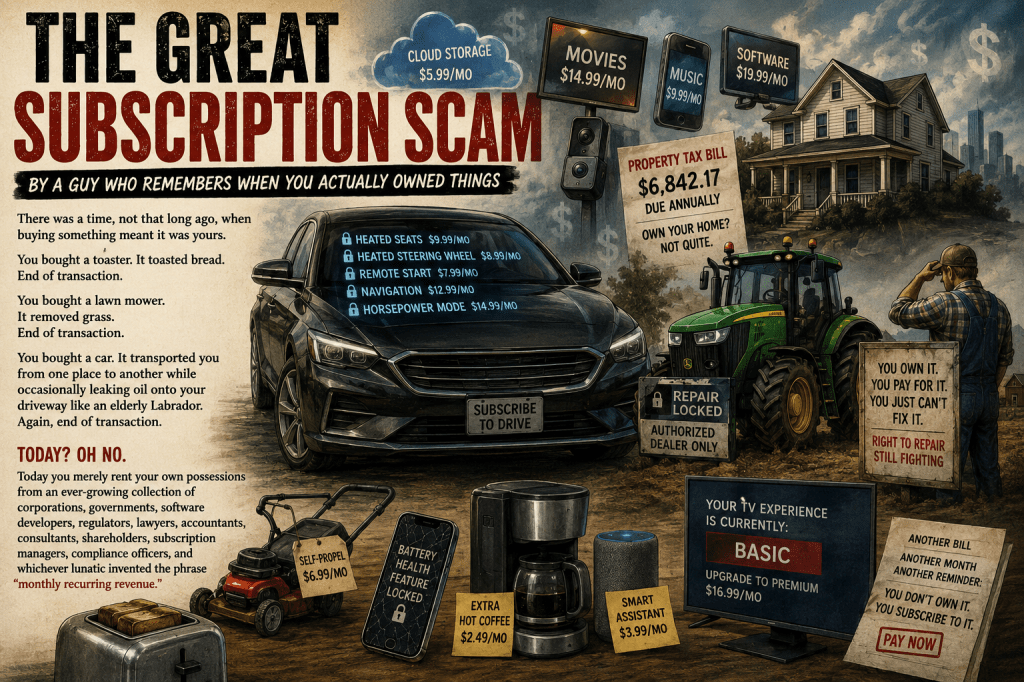
There was a time, not that long ago, when buying something meant it was yours.
You bought a toaster. It toasted bread. End of transaction.
You bought a lawn mower. It removed grass. End of transaction.
You bought a car. It transported you from one place to another while occasionally leaking oil onto your driveway like an elderly Labrador.
Again, end of transaction.
Today?
Oh no.
Today you merely rent your own possessions from an ever-growing collection of corporations, governments, software developers, regulators, lawyers, accountants, consultants, shareholders, subscription managers, compliance officers, and whichever lunatic invented the phrase “monthly recurring revenue.”
Let’s start with cars.
Once upon a time, a car had four wheels, an engine, and a radio that only picked up static and baseball games.
If a headlight bulb burned out, you opened the hood, removed the bulb, installed a new one, and celebrated your mechanical brilliance with a sandwich.
Now?
Changing a headlight bulb requires the removal of half the front bumper, three plastic covers, an electrical module, and possibly a permit from the Department of Homeland Security.
I recently looked up how to replace a simple bulb on a modern luxury car.
Step one involved removing the front wheel.
The front wheel.
For a light bulb.
At this point, replacing a bulb is less a maintenance task and more a doctoral thesis.
And don’t even mention oil changes.
Remember when you could crawl underneath your car with a wrench and emerge an hour later covered in enough grease to permanently ruin your marriage?
Now the vehicle’s computer throws a tantrum if it detects that someone other than an authorized technician has touched it.
You don’t own the machine.
You merely supervise it.
And while we’re discussing ownership, let’s talk about price.
Good Lord.
Cars used to be expensive.
Now they’re absurd.
The average new vehicle price has climbed into territory that was once reserved for small houses, functioning kidneys, and minor European kingdoms.
Every week I see advertisements proudly announcing monthly payments that look suspiciously similar to mortgage payments.
For a pickup truck.
A pickup truck, not a helicopter and certainly not a yacht.
A machine originally designed to transport fence posts, bags of fertilizer, and occasionally your brother-in-law’s poor life choices.
Then there are the rumors.
To be fair, much of this remains speculation, and not every manufacturer is doing it.
Yet.
But enough companies have flirted with subscription-based features to make people nervous.
Heated seats.
Heated steering wheels.
Remote start.
Enhanced navigation.
Extra performance modes.
The hardware is already sitting there inside the vehicle.
You’ve already paid for it.
The heating elements are physically inside the seat.
The steering wheel is perfectly capable of warming your frozen fingers on a January morning.
But somewhere in a boardroom, a man with an MBA and a PowerPoint presentation is allegedly staring at these features and wondering:
“How do we charge them twice?”
Imagine buying a house and discovering your staircase only works if you’ve renewed your Premium Mobility Package.
Imagine purchasing a refrigerator and finding out ice cubes require a monthly subscription.
Ridiculous?
Perhaps.
But ten years ago, if I had told you people would pay monthly fees to watch television, listen to music, store photographs, use software, and ring their own front doorbell, you would have suggested I seek professional help.
Today that’s called Tuesday.
And it’s not just cars.
Look around.
Your television wants a subscription.
Your music wants a subscription.
Your movies want a subscription.
Your software wants a subscription.
Your doorbell wants a subscription.
Your cloud storage wants a subscription.
Soon your toaster will refuse to brown a bagel until you’ve accepted updated terms and conditions.
Then there are the farmers.
Now, farmers are not generally known for sitting around discussing software licensing agreements.
If something breaks, they fix it.
That’s the arrangement.
It’s worked reasonably well ever since mankind stopped chasing mammoths and started growing potatoes.
But then along came a certain agricultural equipment company.
I won’t mention names.
Let’s just say if somebody asked, “Oh dear, did John shoot the deer?” you’d be getting warmer.
Over the years, many farmers became increasingly frustrated because modern agricultural equipment became heavily dependent on proprietary software, dealer-controlled diagnostics, and systems that often required authorized access.
The complaint was surprisingly simple.
A farmer could spend hundreds of thousands of dollars on a tractor.
Own it.
Insure it.
Maintain it.
Store it.
Make payments on it.
And yet still find that certain repairs or diagnostic functions required involvement from the manufacturer or dealer.
Think about that.
Your grandfather could rebuild an engine under a tree using tools that looked as though they had survived two world wars.
Today’s farmer may need software permissions, specialized diagnostics, dealer authorization, and a laptop that costs more than your first car.
The issue grew large enough to spark lawsuits, regulatory scrutiny, and years of debate over what’s now known as the right-to-repair movement.
And honestly, you can understand why.
If a combine harvester breaks during harvest season, nature doesn’t care.
Rain doesn’t stop.
Crops don’t pause.
A thunderstorm has never once announced:
“Don’t worry, Earl. We’ll hold off until customer support gets back to you.”
Many farmers felt that although they physically owned the machine, someone else still controlled part of it.
And that’s the part that should worry all of us.
Because once ownership becomes dependent on permission, it’s not really ownership anymore.
It’s a very expensive form of supervised borrowing.
The truly remarkable achievement was that a company selling machinery to cattle farmers somehow managed to make the farmers feel like the actual cash cows.
Forgive the pun.
Unlike software updates, that joke was included at no additional charge.
Then there are phones.
People say they own their phones.
Do they?
Really?
The manufacturer controls the software.
The carrier controls the service.
The app stores control what can be installed.
The battery is glued in with what appears to be material borrowed from a spacecraft assembly facility.
Try repairing one yourself and you’ll discover that the device apparently contains seventeen microscopic screws manufactured exclusively by a wizard living in a cave.
Again, ownership has become theoretical.
You possess the object.
Someone else possesses the control.
Which brings us neatly to houses.
You spend thirty years paying off a mortgage.
Thirty years.
Thousands of mornings.
Thousands of workdays.
Thousands of hours sitting in traffic wondering where your life went.
Eventually, after decades of sacrifice, the bank finally says:
“Congratulations. The house is yours.”
Wonderful.
Except it isn’t.
Because now comes property tax.
The annual reminder that while you may own the building, somebody else still owns a piece of your wallet.
Now before anyone writes an angry letter, I understand the argument.
Property taxes help fund schools, roads, emergency services, and local government.
Fair enough.
Nobody wants roads that resemble a lunar expedition.
But there is something deeply peculiar about spending your entire working life paying for a home only to discover that stopping payments later can still put that home at risk.
Imagine buying a sandwich and then being told every year thereafter that continued possession of the sandwich requires an additional fee.
You’d think the seller had escaped from an asylum.
Yet with houses we’ve somehow accepted this arrangement as normal.
A retired couple can own their home outright and still face rising tax bills year after year because the assessed value increased while their income did not.
The house didn’t get bigger.
The roof didn’t suddenly become gold-plated.
The owners didn’t win the lottery.
The paperwork changed.
And now they owe more money.
It’s enough to make a man stare at an empty field and seriously consider living in a shed.
Of course, governments aren’t entirely to blame.
Corporations have become extraordinarily skilled at discovering new ways to charge people for things they already purchased.
The modern economy appears to operate on one guiding principle:
“If customers have money left, we haven’t tried hard enough.”
Every product now comes with tiers.
Bronze.
Silver.
Gold.
Premium.
Premium Plus.
Premium Ultra.
Premium Ultra Max Executive Signature Platinum Elite Founder’s Edition.
By the time you’ve finished selecting options, you’ve accidentally financed a small moon landing.
And all of this arrives against the backdrop of wars, inflation, supply chain disruptions, tariffs, economic uncertainty, and enough global drama to keep financial news channels screaming twenty-four hours a day.
Every company claims costs have increased.
Some undoubtedly have.
Others seem to have interpreted world events as a once-in-a-generation opportunity to see just how much money they can extract before customers begin hurling patio furniture through office windows.
So here we are.
Paying subscriptions for entertainment.
Renting software.
Financing vehicles that cost more than our parents’ first houses.
Paying annual taxes on property we supposedly own.
Watching farmers argue that they should be allowed to repair the equipment sitting in their own barns.
And wondering whether ownership itself has become an outdated concept.
Perhaps the future is simple.
Maybe one day you’ll own absolutely nothing.
Not your car.
Not your house.
Not your phone.
Not your television.
Not even your toaster.
You’ll merely subscribe to existence.
And somewhere, in a glass office tower, a man in a very expensive suit will be calculating a monthly fee for oxygen.
Knowing our luck, there will be a premium package.
Unlimited breathing.
Only $19.99 per month.
Thanks for dropping by my little corner of the world. If the story gave you a chuckle or made you pause and think, a like would be mighty kind. And if you’re feeling adventurous, well, hitting that subscribe button is like pulling up a chair and staying a while—always room for one more.
I subscribe back, by the way. It’s my way of saying, “Welcome to the club—snacks are in the back, good times up front!”
Your comments make me smile, sometimes laugh out loud, and every now and then, they nudge me to dig a little deeper, write a little better. So, stick around—who knows what we’ll stumble upon next!
My book, Hidden Alignment is still available on Amazon in paperback and Kindle for those interested. Link and QR code below.
Link: https://a.co/d/0enjFI6f



![You Will Own Nothing And You Will Like It! [Reblog!] - Wearing2Gowns Avatar](https://wearing2gowns.blog/wp-content/uploads/2025/07/wp-1752284208256.webp?w=40)


Leave a Reply