By a man who would quite like gas to stop behaving like vintage champagne
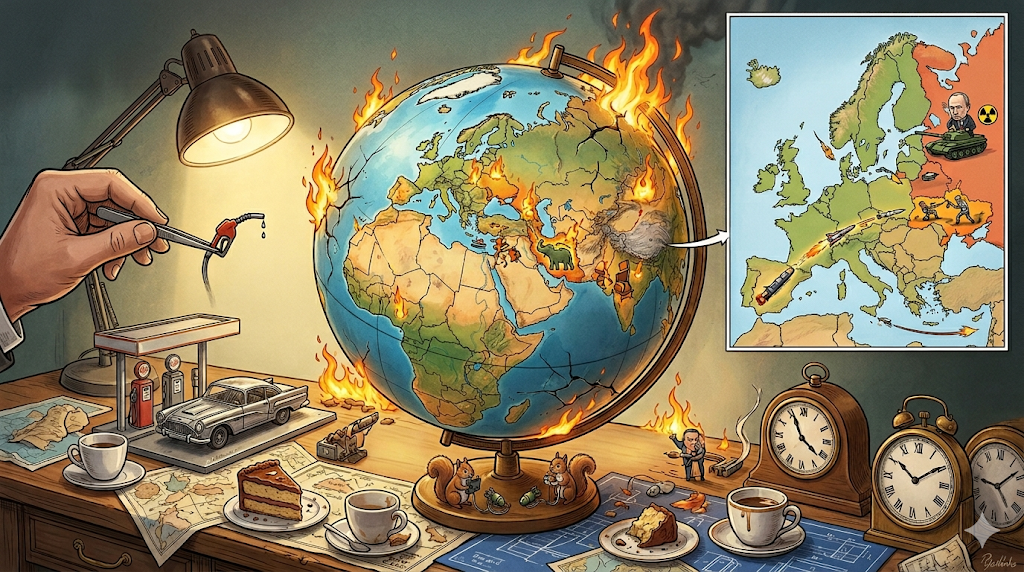
There was a time—glorious, naïve, almost suspiciously peaceful—when the biggest global concern was whether your neighbor had stolen your recycling bin. Now, however, the planet appears to be run by a committee of caffeinated squirrels armed with nuclear codes.
Let’s begin with Vladimir Putin, who continues to loom over world affairs like a man who insists he’s fixing the plumbing while the house quietly floods. Somewhere in the middle of all this, Iran and Israel have decided that subtle disagreement is overrated and have instead gone for the geopolitical equivalent of throwing chairs across the room.
Naturally, this has turned the Strait of Hormuz into the world’s most expensive traffic jam. Oil tankers are hesitating, markets are panicking, and gas prices have shot up so dramatically that filling your car now feels like sponsoring a small war effort.
Which leads to the obvious pub question: why doesn’t the United States just march in, take the Strait of Hormuz, and be done with it?
Because that, dear reader, is like solving a kitchen fire by dropping a grenade into the oven. Yes, the fire would technically go out, but so would everything else—including your house, your neighborhood, and quite possibly Belgium.
Meanwhile, the United Kingdom—normally America’s ride-or-die companion in global escapades—has taken a step back. Not a dramatic step. More of a polite British shuffle accompanied by, “We fully support you… from over here… with tea.”
And Canada?
Canada hasn’t vanished. It’s just standing off to the side, arms folded, giving America that look.
Which, to be fair, is entirely reasonable when your neighbor starts lobbing economic hardship your way and—just for variety—floats the idea that you might fancy becoming the 51st state.
“Sorry,” Canada says, “the what now?”
Because let’s be honest, if anyone’s absurdly first in line for that sort of thing, it’s England. They’d arrive with tea, a queue, and a 400-page apology for the weather. And even then, they’d insist on driving on the wrong side just to keep things interesting.
As for the 52nd state—already taken. Greenland. Obviously. A strategic masterstroke if your long-term plan involves ice, polar bears, and confusing maps.
Which leaves 53 politely reserved for Puerto Rico, and 54 for Washington, D.C., who’ve been standing there for years going, “Hello? Anyone? We live here.”
So no, Canada isn’t going anywhere.
It’s just a bit fed up at the moment. And rightly so.
But underneath the eye-rolls and the well-earned irritation, it’s still the same relationship it’s always been—neighbors, friends, and the one person in the room quietly hoping America stops talking long enough to make sense again.
Then we have China and Russia, who seem to treat global crises like an opportunity to ask, “What’s the most inconvenient position we could possibly take?” and then proudly stand there.
And speaking of Russia—this is where it gets properly uncomfortable for Europe.
Because it’s not just Ukraine anymore. Russia remains the single biggest threat to European security, with ongoing military pressure, hybrid warfare, and the occasional not-so-subtle nuclear saber-rattling thrown in for dramatic effect . There are even fresh warnings about space-based weapons and broader escalation risks that could affect the entire continent .
In other words, Europe is sitting there quietly sipping espresso while a man outside revs a tank engine and occasionally shouts, “Lovely continent you’ve got there… shame if something happened to it.”
And then there’s the added bonus round: a potentially nuclear-capable Iran. Because what Europe really needs right now—on top of energy shocks, war on its doorstep, and economic strain—is another power with missiles that can reach the continent. Yes, those same missile programs have been openly discussed as being capable of threatening Europe as well as U.S. assets .
So, Europe now gets to enjoy a delightful geopolitical sandwich: Russia on one side, Iran possibly going nuclear on the other, and absolutely no comfortable place to sit.
And speaking of Russia—this is where it gets properly awkward.
Because while Moscow postures like a heavyweight champion, Ukraine—a country smaller, scrappier, and with considerably fewer toys in the shed—has been landing punches like a guy who’s just discovered the bigger guy ate his lunch. What was supposed to be a quick, decisive operation has instead turned into the geopolitical equivalent of trying to swat a wasp and accidentally setting your own pants on fire.
Ukraine, against expectations, has held ground, pushed back, and generally behaved like the sort of opponent that refuses to read the script. It’s David versus Goliath—if David had drones, grit, and absolutely no intention of losing.
Back in the Middle East, groups like Hezbollah continue to stir the pot in ways that make an already boiling situation bubble over. The international mood toward them is about as warm as a freezer in January, with mounting pressure to dismantle their influence before the whole kitchen goes up in flames.
Now, let’s address the rather large, uranium-shaped elephant in the room.
There is a long-standing pattern of hostile rhetoric from elements within Iran’s leadership directed at both Israel and the United States—language widely interpreted as threats of destruction. Not subtle threats either. More the sort of thing that sounds like someone announcing, loudly and repeatedly, that they’d quite like to erase two countries off the map.
So when people say, “What’s the big deal about Iran going nuclear?” the answer is: because giving nuclear capability to a regime associated with repeated threats toward Israel and the United States—and with ambitions to dominate its region—is like handing a flamethrower to someone who’s already shouting about burning the entire neighborhood down.
And yes—whatever one thinks of Donald Trump—and opinions range from “strategic genius playing 4D chess while everyone else is still reading the rules” to “a man who treats every microphone like it owes him money”—there is a rare, almost miraculous agreement: a nuclear-capable Iran is a terrible idea.
Because we already have North Korea, which is essentially the geopolitical equivalent of a locked room with a tiger inside. Adding another—bigger, richer in oil, and sitting at the crossroads of everything important—isn’t bold strategy. It’s asking for trouble in several languages at once.
In South America, meanwhile, Venezuela and Argentina are now behaving like newly minted American allies—an unexpected twist, like finding out your two most chaotic friends have suddenly decided to wear suits and discuss trade policy.
Over in Lebanon, things remain as tense as a cat in a room full of rocking chairs, largely because it sits in the exact spot where everyone else’s problems like to collide.
And then we arrive, with a sigh and a raised eyebrow, at the Philippines.
Because here’s the thing. When corruption siphons off public money—money meant for hospitals, roads, safety—you don’t just get inefficiency. You get people suffering. You get people dying. Needlessly. Quietly. That is the real human rights violation.
And yet, in the same breath, you have Rodrigo Duterte—viewed by critics as controversial, by supporters as someone who tried to impose order and push through one of the largest infrastructure expansions in the country’s history—connecting north to south and reaching communities long ignored, including indigenous populations.
So when critics from France, Netherlands, and Belgium start waving fingers from comfortable distances, one is tempted to say: you’ve got the wrong guy, you stupid pretenders.
Back in the United States, gas prices are climbing like they’ve just remembered they left the stove on. People are suddenly driving as if acceleration personally costs them dignity. Lawmakers are proposing everything from export bans to strongly worded letters, which historically have had the stopping power of a damp sponge.
And all of this is happening at once.
It’s like watching a grand orchestra where every musician has decided to play a different song, in a different key, while occasionally setting their instrument on fire.
Yet somehow, the world keeps going. Flights still depart. Coffee is still overpriced. And somewhere, someone is still insisting that things are “largely under control,” which is exactly what you say moments before everything goes spectacularly wrong.
If history has taught us anything, it’s that humanity doesn’t collapse in one dramatic, cinematic explosion.
No, it does something far more irritating.
It muddles through.
It argues.
It raises gas prices to levels normally associated with rare gemstones.
And then it carries on—slightly singed, mildly confused, and wondering why everything suddenly costs twice as much.
Honestly, at this point, the most shocking development would be if something, somewhere, actually made sense.
Thanks for dropping by my little corner of the world. If the story gave you a chuckle or made you pause and think, a like would be mighty kind. And if you’re feeling adventurous, well, hitting that subscribe button is like pulling up a chair and staying a while—always room for one more.
I subscribe back, by the way. It’s my way of saying, “Welcome to the club—snacks are in the back, goodtimes up front!”
Your comments make me smile, sometimes laugh out loud, and every now and then, they nudge me to dig a little deeper, write a little better. So, stick around—who knows what we’ll stumble upon next!
If you’re feeling a little generous—like the world’s got just enough warmth left in it for a small kindness—wander on over to my Donate page. No pressure, just a gentle nudge from the universe, saying, “Hey… this might be worth it.


 A Kings
Leave a reply to Priscilla Cancel reply