By a guy who has been tailgated, politely apologized to, aggressively gestured at, spiritually tested, mildly terrified, and once overtaken by a vehicle carrying livestock.
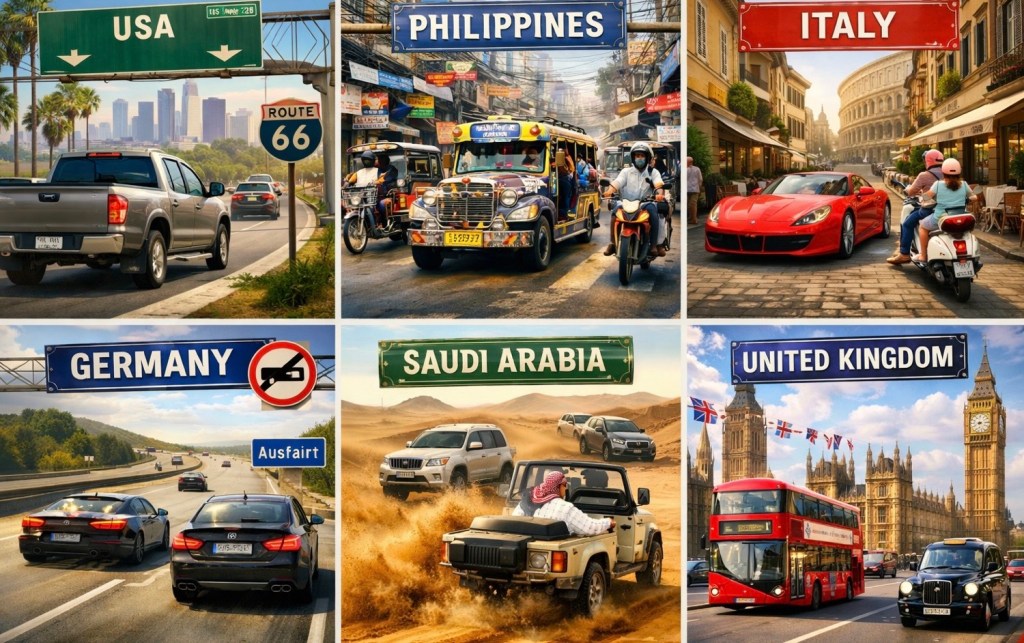
There are many great mysteries in life. Why toast always lands butter-side down. Why socks vanish in the laundry. And, perhaps most baffling of all, how eight billion people, armed with machines capable of highway-speed destruction, have collectively agreed to call what they do on the road “driving.”
Let us begin in United States, where the concept of “lanes” exists in much the same way that pirates view the Pirate Code—more of a guideline than an actual rule.
In theory, the right lane is slow, the middle is for cruising, and the left lane is for overtaking. In reality, all lanes are treated with the same philosophical indifference as a buffet line at a questionable hotel. You’ll find a man in a pickup truck doing 52 mph in the fast lane, utterly unbothered, possibly contemplating life, possibly listening to country music, definitely unaware that behind him is a growing convoy of increasingly furious citizens.
And what do Americans do about this? Nothing. They simply undertake, overtake, weave about like caffeinated squirrels, and carry on. It’s less “orderly traffic system” and more “democracy in motion.”
Then we cross the pond to United Kingdom, where driving is governed not just by rules, but by an unspoken code of politeness so powerful it could probably stop a war.
Here, road rage consists of what can only be described as a firmly worded glance. A honk of the horn is practically a declaration of war. And if someone dares to make a vigorous hand gesture, it is treated with the same gravity as a parliamentary scandal.
You could accidentally reverse into someone’s car, set it on fire, and their response would likely be:
“Oh terribly sorry, I might have been in your way.”
Meanwhile, traffic flows with a sort of apologetic grace. Indicators are used. Lanes are respected. It’s all very civilized… and faintly unsettling, like a dinner party where no one ever argues.
Now, to Italy—where all of that goes out the window, is run over, reversed over again, and then gestured at wildly.
Driving here is not a system. It is an art form. A performance. A full-contact sport with hand signals.
Traffic lights? Suggestions.
Lane markings? Decorative.
Personal space? Absolutely not.
An Italian driver can overtake you, argue with you, flirt with someone on the sidewalk, and sip an espresso—all simultaneously and without spilling a drop. It is chaos, yes, but it is confident chaos. The sort of chaos that somehow works because everyone is equally committed to the madness.
You don’t drive in Italy. You participate.
Then, of course, there is Germany, where driving is elevated to something approaching a religion.
Here, rules are followed with such precision that even the sat-nav sounds nervous. The autobahn—glorious, unrestricted in parts—is not a place for hesitation. It is a proving ground.
You may be cruising along at what you believe is a respectable speed when, suddenly, a sleek German saloon appears behind you, doing approximately the speed of light, flashing its headlights with the quiet authority of a man who has read the manual and expects you to have done the same.
And you move. Immediately. Because in Germany, the left lane is sacred. Misuse it, and you will be corrected—not with anger, but with terrifying efficiency.
Now we arrive in Philippines, where the word “traffic” doesn’t quite capture what’s going on.
This is not driving. This is survival.
Rules exist, technically, but they are treated more like folklore—stories passed down through generations that no one quite believes. Jeepneys stop wherever they please. Motorcycles appear from dimensions previously unknown to physics. Pedestrians cross with the calm confidence of people who have accepted their fate.
At any given moment, you may find yourself surrounded by buses, tricycles, cars, dogs, and a man selling snacks—in the middle of the road.
And yet, somehow, it works. There is a strange, organic rhythm to it all. A kind of negotiated chaos where eye contact replaces traffic lights and sheer instinct keeps everyone alive.
Finally, we land in Saudi Arabia, where the automobile of choice is not merely a vehicle—it is a statement. Preferably a very large, very expensive SUV.
Here, Chevy Suburban SUVs roam the roads like mechanical elephants. The bigger, the better. A Range Rover is considered a sensible runaround.
And yes, it is entirely possible—and not even particularly surprising—to see one with sheep in the back. Actual sheep. Just there. As if this were the most normal thing in the world.
Driving itself is… spirited. Indicators are optional, speed is enthusiastic, and the general vibe suggests that everyone is late for something extremely important, even if they’re not entirely sure what it is.
It is, in short, magnificent.
So there you have it. Around the world, humanity has taken the simple act of moving from one place to another and turned it into a dazzling array of cultural expressions—from polite choreography to operatic chaos.
And the truly astonishing thing?
Despite all of this—despite the lane hoggers, the polite apologizers, the espresso-fueled daredevils, the rule-abiding speed merchants, the chaos navigators, and the sheep-hauling SUV enthusiasts—we all, more or less, get where we’re going.
Which, when you think about it, is either a triumph of human adaptability…
Or a complete miracle.
Thanks for dropping by my little corner of the world. If the story gave you a chuckle or made you pause and think, a like would be mighty kind. And if you’re feeling adventurous, well, hitting that subscribe button is like pulling up a chair and staying a while—always room for one more.
I subscribe back, by the way. It’s my way of saying, “Welcome to the club—snacks are in the back, goodtimes up front!”
Your comments make me smile, sometimes laugh out loud, and every now and then, they nudge me to dig a little deeper, write a little better. So, stick around—who knows what we’ll stumble upon next!
If you’re feeling a little generous—like the world’s got just enough warmth left in it for a small kindness—wander on over to my Donate page. No pressure, just a gentle nudge from the universe, saying, “Hey… this might be worth it.”


 A Kings
Leave a reply to Bronlima Cancel reply