By a man who is beginning to wonder if we’ve misplaced it
There are days when I look at America and think, For God’s sake, can we all just calm down and get along?
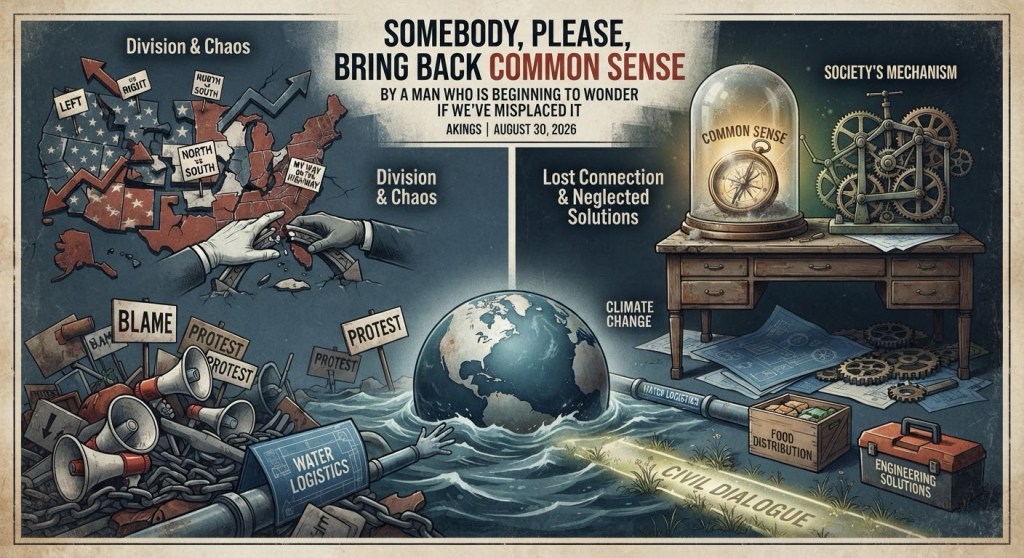
North against South. Left against Right. East against West. Republicans against Democrats. Men against women. Israelis against Palestinians. Everybody against everybody, apparently, and if you can find two people who agree on something, someone will probably arrive shortly afterward to explain why they are both wrong.
It is exhausting.
And what makes it worse is that it doesn’t have to be this way.
The people who founded this country understood something rather important: people are going to disagree. They knew there would be arguments. They knew there would be factions, passions, competing interests and the occasional politician who could talk for three hours without actually saying anything.
So they built a system that was supposed to allow people to argue, debate, disagree and eventually decide what was best without resorting to throwing furniture at one another.
It was, frankly, a rather clever arrangement.
The trouble is that the system requires something which apparently wasn’t included in the original package.
A working brain.
And a decent supply of that increasingly rare substance known as common sense.
Because you can write the finest constitution in the history of mankind, but if the people operating the machinery have forgotten how to think, you’re basically handing a Ferrari to a man who believes the accelerator is the brake.
I was reminded of this recently when I watched a YouTube video featuring a doctor who was asked by a senator to define what a woman is.
Now, this was not some woman who had wandered in from a gas station carrying a burrito with drool allover her face.
This was a doctor.
Someone who had gone through medical school. Someone who presumably had studied human anatomy, biology and the reproductive system. Someone who had spent years learning what the human body does, doesn’t do, and occasionally does at three in the morning when it really shouldn’t.
And yet this person apparently couldn’t give a straightforward answer.
I’m sorry, but something has gone spectacularly wrong when a doctor cannot explain what a woman is.
My parents taught me something very simple when I was growing up: respect women.
Not because women need to be put on a pedestal, but because women have responsibilities, strengths, complexities and qualities that are uniquely their own. My father and mother taught me that women deserve respect and, where necessary, protection.
That wasn’t hatred of men.
It wasn’t oppression.
It was called having manners.
So let me put it as plainly as I can.
A woman is an adult human female.
Women are the ones who, biologically speaking, can carry and give birth to children. They are our mothers, sisters, aunts and grandmothers. They are half of humanity.
This shouldn’t require a twelve-person committee, three academic papers and a government hearing.
If we’ve reached the point where perfectly ordinary biological facts have become unspeakable because someone might be offended by them, then perhaps the problem isn’t biology.
Perhaps the problem is us.
And while we’re busy arguing over this, we have another rather enormous problem unfolding in the Middle East.
The phrase “Free Palestine” has become almost a universal protest slogan in some parts of the Western world. And people are perfectly entitled to protest. That’s one of the great things about living in a free country.
But I do sometimes wonder where the target has gone.
Because if you want to know who has spent decades murdering civilians, terrorizing populations, persecuting people for what they believe, what they wear or who they are, and dragging entire regions into misery, perhaps we should start by looking at the extremists who are actually doing those things.
Instead, somehow, Israel and America routinely end up being presented as the root of every problem in the Middle East.
Really?
Have we stopped reading history?
Have we stopped asking questions?
Who has ruined Lebanon? Who has devastated Syria? Who has made Iran an extremist nation threatening genocide towards the Jews and the western world? And that’s only before breakfast, by lunch time it’s terrorizing its neighbors, by evening, the rest of the world through their support of terrorist groups.
Who flew aircraft into the Twin Towers? Who murdered people on London’s Underground and buses? Who slaughtered people in Paris, Madrid and Mumbai? Who has carried terrorism into countries around the world, including Australia and the Philippines?
And before someone starts shouting at me, I’m not saying every Muslim is a terrorist. Quite the opposite.
Most ordinary people caught in these conflicts are victims. Palestinians included. They’re just the victims of their own extremist problems, they’re called Hamas, so as not to confuse anyone. But evidently, people shouting free Palestine are.
And that is precisely the point.
The enemy isn’t an ethnicity.
It isn’t a nationality.
It isn’t a religion.
It is extremism.
Extremism in any form that says, You are different from me, therefore you deserve to die.
That is evil.
And we should have the courage to call it evil regardless of who is doing it. This isn’t bigotry. Again, this should be common sense.
You don’t fight extremism by hating an entire population. You fight it by identifying the extremists and refusing to let them define everyone else.
But apparently this is complicated now.
Meanwhile, while America and the rest of the civilized world are busy screaming at one another, the planet has quietly wandered into another set of problems.
Weather.
Lots of it.
We’re seeing major swings between floods and droughts, with some places drowning while others desperately need water. Climate systems are complicated, and I’m quite happy to leave the detailed science to people who have spent their lives studying oceans and atmospheric circulation.
But here’s the bit I don’t understand.
If half the world has too much water and another part doesn’t have enough, why aren’t we spending more of our considerable human ingenuity figuring out how to move water from the wet bits to the dry bits?
We can land reusable rockets.
We can put robots on Mars.
We can make a telephone that recognizes our face while simultaneously knowing where we’ve left our keys.
Surely we can move water.
And then there’s food.
In one part of the world, people are eating themselves into an early grave because food is so plentiful that we’re discussing obesity as a public-health crisis.
In another, people are starving.
Again: this is not dark matter.
It’s logistics.
We already know how to move things. We have ships, trucks, trains, airplanes, pipelines, refrigeration, warehouses and enough computers to calculate the delivery route for a pizza from Houston to your front door.
So perhaps we could apply some of that extraordinary human ingenuity to moving food toward people who don’t have any.
And yes, we can argue about wealth.
We can argue about taxes, capitalism, socialism, government spending, corporate greed, poverty and everything else under the sun.
But let’s at least argue about things that matter.
Because these problems are difficult, but they aren’t necessarily impossible.
We should.
They require money.
They require engineering.
They require cooperation.
They require time.
Most importantly, they require people to stop treating everyone on the opposite side of an argument as though they are the enemy.
That’s the part I find most depressing.
We’ve somehow convinced ourselves that disagreement is hatred.
It isn’t.
My neighbor can believe something completely different from me and still be my neighbor.
My friend can vote differently from me and still be my friend.
A person can worship differently from me, dress differently from me, come from somewhere completely different from me and still be entitled to live in peace.
That’s civilization.
You don’t have to agree with everyone.
You just have to learn how to live with them.
The founding fathers gave us a framework for doing exactly that. They gave us rules that allow us to argue without killing each other.
What they couldn’t provide was the common sense required to use those rules properly.
That bit was apparently supposed to be supplied by us.
So perhaps we should start there.
Let’s stop pretending every disagreement is a declaration of war.
Let’s stop turning human beings into political categories.
Let’s stop blaming entire populations for the crimes of extremists.
Let’s respect women without being frightened of the word “woman.”
Let’s identify evil without inventing convenient enemies.
Let’s get water to places that need water.
Let’s get food to people who need food.
Let’s argue about wealth and figure out how to make opportunity less dependent on where someone happened to be born.
And let’s remember that no extremist ideology, from any side, has ever produced a better future for ordinary people.
Eventually, we are going to have to learn to live together.
Because the planet isn’t going to wait for us to finish arguing.
And perhaps that’s the great joke of all.
We’re sitting here screaming at one another about which team we’re on while the house is slowly filling with water.
Maybe, just maybe, we should put down the political signs, pick up a bucket and start working together.
It might be the first sensible thing we’ve done in a while.
Maybe.
I wouldn’t bet the house on it.
But then again, if we can put a man on the Moon, perhaps there is still hope that we can teach one another how to use a brain.
And, with a bit of luck, find the common sense that seems to have gone missing somewhere along the way.
Thanks for dropping by my little corner of the world. If the story gave you a chuckle or made you pause and think, a like would be mighty kind. And if you’re feeling adventurous, well, hitting that subscribe button is like pulling up a chair and staying a while—always room for one more.
I subscribe back, by the way. It’s my way of saying, “Welcome to the club—snacks are in the back, good times up front!”
Your comments make me smile, sometimes laugh out loud, and every now and then, they nudge me to dig a little deeper, write a little better. So, stick around—who knows what we’ll stumble upon next.


 A Kings
Leave a comment