By a guy who was sitting in a restaurant in Saudi Arabia on a Tuesday morning when the world changed, and who has never quite forgotten the silence that followed the news…
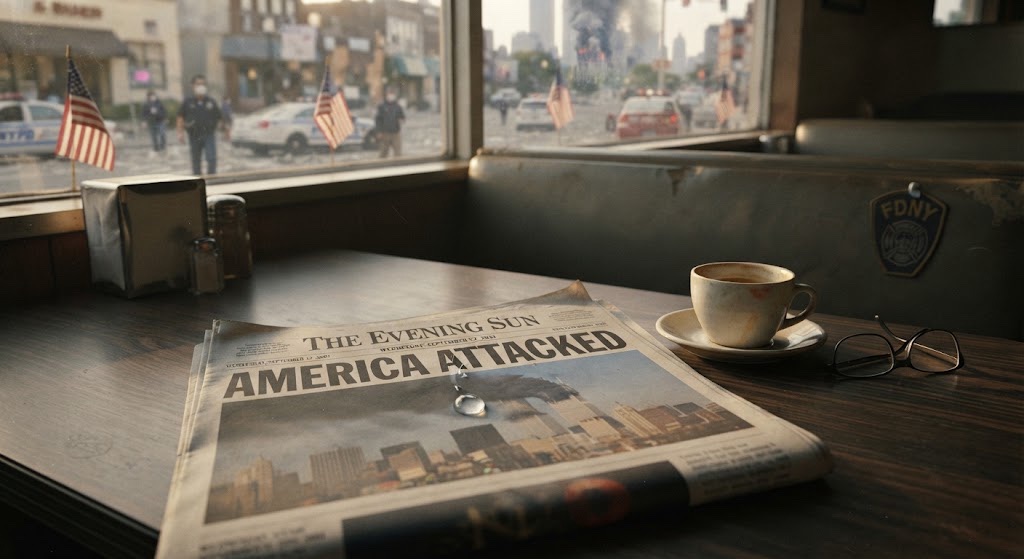
There are days that belong to history, and then there are days that seem to belong to something deeper than history. Days that become part of the memory of an entire generation. September 11 is one of those days.
I remember where I was.
I was in Saudi Arabia, there for work, sitting in a restaurant having a late lunch when the news came on. At first, there was confusion. Then disbelief. Then that awful moment when you realize that what you are watching is not a movie, not some terrible accident, not something happening somewhere far away that will be explained away in a few minutes.
It was happening to America.
And I remember the feeling.
It was as though the blood had suddenly left my body.
New York was burning. A plane had been turned into a weapon. Another had struck the other tower. The Pentagon had been attacked. And somewhere in Pennsylvania, ordinary people were about to become heroes.
The people in those buildings were not symbols that morning. They were people.
Fathers going to work.
Mothers going to work.
Brothers and sisters.
Husbands and wives.
Young people beginning careers and older people finishing them.
White Americans, Black Americans, Hispanic Americans, Asian Americans. Christians, Jews, Muslims, people of other faiths and people of no faith at all. Americans and foreigners who happened to be in the wrong place on the wrong morning.
They were simply going to work.
They never came home.
And then there were the firefighters, police officers, paramedics and other first responders who ran toward the buildings while everyone else was trying to escape them.
They knew something terrible was happening.
They went anyway.
Some never walked back out.
Their families paid the price too. Wives became widows. Husbands became widowers. Children grew up without a mother or father. Parents buried sons and daughters who had gone to work that morning believing, as most of us do every morning, that they would be home that evening.
And we must never forget the people aboard those airplanes.
They were not statistics. They were not merely passengers on Flight 11, Flight 175, Flight 77 and Flight 93.
They were human beings.
People who had families waiting for them.
People who had birthdays coming.
People who had plans for that evening, that weekend, that year.
And then they were murdered because somebody decided that an airplane could become a weapon.
I remember something else from that day, something that disturbed me almost as much as the attacks themselves.
I remember seeing people celebrating.
Cheering.
Not grieving. Not horrified. Celebrating.
America had been wounded, and for some people around the world, that was apparently a reason for joy.
I could not understand it then, and I still struggle to understand it now.
America, for all its imperfections, had spent generations becoming something extraordinary: a country built around the idea that people could come here and become free. A country that has sent food, medicine, money and people into places devastated by earthquakes, hurricanes, wars and famine. A country whose doors have often been opened to people fleeing persecution and violence.
America has made mistakes. Of course it has.
America has never claimed to be perfect.
But the American idea was never supposed to be about perfection.
It was supposed to be about freedom.
Liberty.
The right to speak your mind.
The right to worship—or not worship—as you choose.
The right to become whatever your abilities and determination allow.
The right of a woman to walk down a street without being told that her existence violates someone else’s religious rules.
The right of a gay man or woman to live openly.
The right of a Jew to worship without fear.
The right of a Christian to practice his faith.
The right of a Muslim to practice his faith.
And perhaps most importantly, the right to disagree with all of them.
That is the American experiment.
And here is where I think we have to be honest with ourselves.
Not every culture is compatible with every other culture.
That isn’t hatred. It is reality.
Cultures carry ideas about family, women, authority, religion, individual liberty, the role of government and the rights of the individual. Sometimes those ideas fit comfortably beside one another.
Sometimes they don’t.
And when a belief system says that your freedom to speak is dangerous, that another person’s religion should determine their rights, that women should have fewer freedoms, that violence against people who disagree with you can somehow be justified, or that the destruction of another society is a noble goal, we should not be afraid to say that those ideas are incompatible with American values.
But we must also be careful.
We cannot turn an ideology into a race.
We cannot turn extremists into representatives of every immigrant.
We cannot turn terrorists into representatives of every Muslim, nor should we. But neither should we be afraid to ask an uncomfortable question: where is the condemnation when evil claims to act in your name? Extremists do not speak for an entire faith, but when they invoke that faith to justify murder, silence cannot be the answer. Evil deserves condemnation from everyone—but especially from those whose religion, culture, or community these extremists claim to represent. Without that condemnation, suspicions inevitably arise. And those uncertainties deserve honest answers.
The question isn’t where someone’s grandfather was born.
The question is what they believe.
Do you believe in the Constitution?
Do you believe your neighbor has the same rights you do?
Do you believe women are equal under the law?
Do you believe religious freedom belongs to everyone?
Do you believe disagreement should be answered with debate rather than violence?
Do you believe America has the right to remain America?
Those are the questions that matter.
And I cannot ignore what I see happening now.
Because memory is not just about the past—it is about whether we recognize the present.
In places like Dearborn, Michigan, and in parts of Wisconsin, there are growing tensions that many Americans are beginning to notice but are often afraid to speak about openly. School board meetings that turn into cultural battlegrounds. Public debates over language, identity, and allegiance. Communities struggling to reconcile deeply different views about religion, law, and civic life.
Some of it is political noise. Some of it is media distortion. But some of it is real friction—real disagreement over what it means to become part of the American story.
And when you strip away the shouting, the uncomfortable question remains the same:
What happens when the values people bring with them do not align with the values of the country they now live in?
That is not a question of ethnicity.
It is a question of ideas.
Because America is not just a place on a map. It is a set of principles. And those principles only survive if they are understood, accepted, and defended.
We should be able to welcome people without surrendering ourselves.
We should be able to offer refuge without abandoning our principles.
We should be able to be generous without being naïve.
And we should be able to say, without apology, that some things are worth defending.
Because if we lose the ability to defend the values that made this country worth coming to in the first place, what exactly are we defending?
Look across the Atlantic at the old world. Look at the tensions, the divisions, the communities struggling to reconcile competing ideas about identity, religion, freedom and national culture.
And then look home.
Pay attention.
Not with hatred.
Not with hysteria.
Not with suspicion of everyone who looks different.
But with vigilance.
Because a free society cannot remain free if it becomes too frightened to defend the principles that make it free.
September 11 taught us that evil does not always announce itself at the door.
Sometimes it arrives quietly.
Sometimes it hides behind excuses.
Sometimes people convince themselves that what is happening isn’t really happening because acknowledging it would be uncomfortable.
That is why we remember.
Not to live in fear.
Not to seek revenge.
But to remain awake.
So, New York, I ask you again.
Where is that promise?
Where is the promise that we would never forget?
Remember the fathers.
Remember the mothers.
Remember the brothers and sisters.
Remember the strangers who became heroes.
Remember the firefighters who climbed upward while everyone else was running downward.
Remember the police officers who stayed when they could have left.
Remember the passengers who fought back.
Remember the families who waited for people who never came home.
And remember those four airplanes.
Remember that they were filled with human beings before someone decided to turn them into weapons.
Twenty-five years can pass in the blink of an eye.
Buildings can be rebuilt.
Memorials can be constructed.
Generations can grow up knowing September 11 only as something they learned about in school.
But memory is a choice.
So choose to remember.
Stay awake.
Stay vigilant.
And above all, remember what they died for.
New York, you have to remember.
America, we have to remember.
Because some promises are too important to forget.
Thanks for dropping by my little corner of the world. If the story gave you a chuckle or made you pause and think, a like would be mighty kind. And if you’re feeling adventurous, well, hitting that subscribe button is like pulling up a chair and staying a while—always room for one more.
I subscribe back, by the way. It’s my way of saying, “Welcome to the club—snacks are in the back, good times up front!”
Your comments make me smile, sometimes laugh out loud, and every now and then, they nudge me to dig a little deeper, write a little better. So, stick around—who knows what we’ll stumble upon next.


Leave a Reply