by a guy who has driven too many interstate miles, eaten gas-station breakfast burritos of questionable ingredients, paid at least one medical bill that looked like the GDP of a small island nation, and still thinks the view somewhere between Virginia and the Appalachians is one of the best things on Earth.
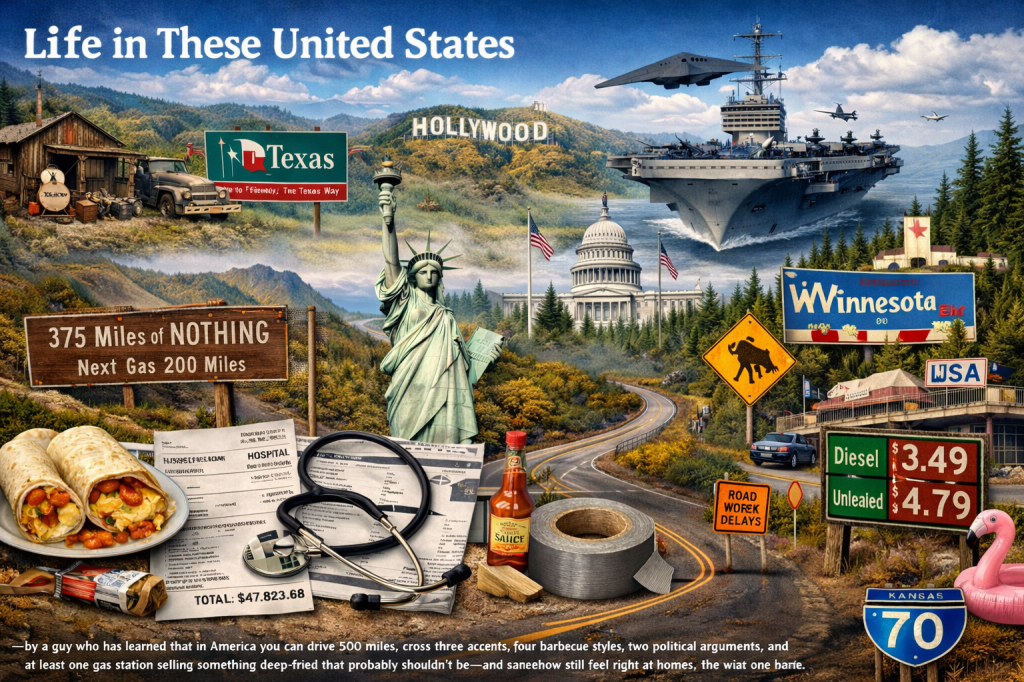
America is a peculiar place. Not peculiar in the way that a man who keeps twelve cats and talks to his mailbox is peculiar, but peculiar in the sense that it somehow manages to be enormous, contradictory, loud, proud, chaotic, generous, slightly mad, and oddly charming all at the same time.
Take the states themselves.
Each one behaves as though it’s an entirely different country that just happens to share a Costco membership with the others.
In West Virginia, for instance, the hills are so steep that even the goats occasionally need a moment to catch their breath. The people are friendly in the way that suggests they could fix your truck, cook you dinner, and tell you the entire history of the Civil War before you’ve finished your coffee. The stereotype, of course, is that everyone there lives in a cabin with a banjo, marries their sister, and has a moonshine still bubbling away behind the shed. This is unfair. Some of them have two sisters and three banjos.
Then there’s Virginia, which is what happens when American history decides to put on a nice blazer and behave itself for a while. Everywhere you go there’s a battlefield, a historic marker, or a house where someone extremely important once had lunch. The people are polite, the accents are gentle, and the traffic around Northern Virginia behaves like a NASCAR event designed by a committee of angry accountants.
California, meanwhile, has the world’s fifth-largest economy and a population that appears to believe that gluten is a government conspiracy. In Los Angeles, people will happily spend $9 on a coffee made from beans that were emotionally supported by Tibetan monks, yet complain loudly about gasoline prices while sitting in traffic in a vehicle the size of a medium apartment building.
Texas is less a state and more a geological attitude. Everything is large. The steaks are large. The pickup trucks are large. The confidence is large. A Texan ordering breakfast will often request eggs, bacon, toast, and what can only be described as a small geological formation of potatoes. If the plate bends slightly under the weight, the restaurant considers this a success.
Up north, in New York, people walk so quickly you’d think the pavement was on fire. The residents of Manhattan can navigate a subway system that resembles a bowl of spaghetti drawn by a mad engineer, yet will panic if they see a squirrel that looks slightly judgmental.
And then there are the states along the Canadian border, which behave like America’s slightly calmer upstairs neighbors. Minnesota, Michigan, and Maine are full of people who say “sorry” even when it clearly wasn’t their fault. In winter the temperature drops so low that even the snow looks concerned. Cars start reluctantly, lakes freeze solid, and everyone develops the quiet resilience of a man who has just shoveled his driveway for the third time before breakfast.
In North Dakota, the wind has been blowing since roughly 1843 and shows no signs of stopping. The locals are perfectly content with this because they have mastered the art of wearing fourteen layers of clothing and still smiling politely at strangers.
And in the South—bless it—you’ll find people so polite they’ll apologize to a chair after bumping into it.
But America’s real charm lies not just in its geography. It lies in its magnificent contradictions.
For example: Americans will argue violently about politics with the intensity of medieval theologians debating angels on the head of a pin. Thanksgiving dinners across the country feature turkey, stuffing, cranberry sauce, and at least one uncle loudly explaining how the entire nation would be fixed if everyone simply listened to him.
The political tribes themselves are fascinating creatures.
On one side you have people convinced the government is trying to regulate the number of teaspoons in their kitchen drawer. On the other side are people who would quite happily create a federal department dedicated entirely to supervising teaspoons.
And yet, when the Fourth of July arrives, everyone suddenly agrees on three things: fireworks are brilliant, grilled meat is essential, and the national anthem should be sung with great enthusiasm even if nobody can remember the third verse.
Then there’s American exceptionalism, which is a bit like owning the world’s biggest barbecue grill and making sure everyone knows it.
America doesn’t merely have an army. It has a military so large that if aliens arrived tomorrow, the Pentagon would probably respond by asking which aircraft carrier group should say hello first. The U.S. Navy has more airplanes than most countries’ air forces, which is the sort of thing that makes geopolitics feel less like diplomacy and more like a very expensive action film.
Of course, the country that can put a robot on Mars and build stealth bombers the size of small office buildings also has a healthcare system that operates a bit like a luxury hotel.
If you’re wealthy, the experience is magnificent. Marble floors. Brilliant doctors. Machines that look like they were designed by NASA.
If you’re not wealthy, however, the process can resemble a negotiation with a very polite but extremely determined accountant.
You may walk into a hospital with a broken arm and walk out three weeks later with a cast, a bill the size of Nebraska, and a sudden interest in learning how to treat minor injuries with duct tape and optimism.
Then there’s the American road system, which stretches across the continent like a ribbon of asphalt ambition.
You can drive for hours through Kansas without seeing anything except sky, wheat, and the occasional gas station that sells both diesel fuel and something described as a “breakfast burrito.” These burritos are fascinating because they appear to contain eggs, sausage, cheese, potatoes, and possibly a small wrench.
Meanwhile, in the big cities, the traffic behaves like a physics experiment designed to test how many cars can occupy the same space while everyone honks at once.
And yet—despite the oddities, the arguments, the stereotypes, the strange breakfast burritos—America has a remarkable quality.
People here believe things can be improved.
They build businesses in garages. They invent ridiculous gadgets. They move across the country simply because they fancy a different view out the window. A person can arrive with a suitcase, a slightly questionable business plan, and an alarming amount of optimism, and somehow end up running a company that sells millions of inflatable flamingos.
This optimism, slightly reckless though it may be, is perhaps the most American thing of all.
Because in these United States, everything is enormous: the distances, the personalities, the arguments, the ambitions, the mistakes, and occasionally the medical bills.
But so, too, is the sense that tomorrow might just be interesting.
And in a country this big, loud, complicated, and occasionally ridiculous…
interesting is guaranteed.
Thanks for dropping by my little corner of the world. If the story gave you a chuckle or made you pause and think, a like would be mighty kind. And if you’re feeling adventurous, well, hitting that subscribe button is like pulling up a chair and staying a while—always room for one more.
I subscribe back, by the way. It’s my way of saying, “Welcome to the club—snacks are in the back, good times up front!”
Your comments make me smile, sometimes laugh out loud, and every now and then, they nudge me to dig a little deeper, write a little better. So, stick around—who knows what we’ll stumble upon next!
My book, Hidden Alignment is still available on Amazon in paperback and Kindle for those interested. Link and QR code below.
Link: https://a.co/d/0enjFI6f



Leave a Reply