By a man who would rather argue about woodland creatures than politics, but here we are.
I must begin with a confession.
I’m slightly hesitant to write this because these days Americans are about as calm and unified as a wasps’ nest someone has just attacked with a lawn mower. The country appears split into two camps who glare at each other across the dinner table like rival sports hooligans, except the hooligans are often more polite and occasionally buy each other a beer afterward.
I do not wish to add to the shouting.
I am not a Republican. I am not a Democrat either. I stand somewhere in the middle like a confused pedestrian on a hi-way, looking left, looking right, and occasionally wondering why everyone else seems so certain about everything. I agree with what seems sensible and disagree with what seems ridiculous. Which, in modern politics, means I’m unpopular with absolutely everyone.
And that’s fine.
Because watching the world these days is, frankly, fascinating.
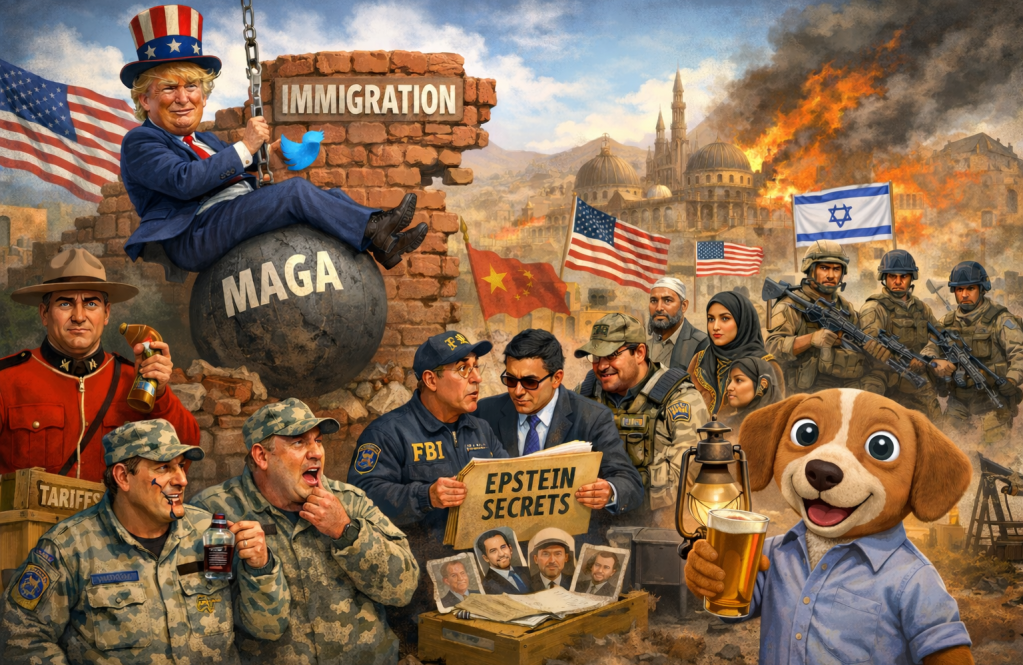
Let’s begin with the president, Donald Trump.
Trump is—how shall we put this delicately—an odd creature. He’s a maverick, a wrecking ball, a walking gossip column with hair that appears to have been styled during a hurricane. He may well be the least religious man ever to walk into a church, yet evangelical leaders adore him like he’s the second coming of John Wayne.
He’s enormously wealthy, has probably never had to wonder whether the gas bill can wait until next Friday, and yet millions of ordinary working Americans absolutely love the man.
He’s said some fairly alarming things about Latinos, and yet many Latinos voted for him.
If this were a character in a television drama, the scriptwriter would be fired for being unrealistic.
Still, politics has always been a strange sport. And as the old saying goes, even a blind squirrel occasionally finds a nut.
Now, on immigration, Trump does have a point. Every country on Earth has borders. And most reasonable people would agree that letting in murderers, cartel thugs, terrorists, and members of gangs like MS-13 is not exactly a winning strategy for neighborhood harmony.
No one wakes up in the morning and says, “You know what would improve the community barbecue? A violent transnational gang.”
However—and this is a rather large however—the people enforcing the rules are another matter entirely.
Take U.S. Immigration and Customs Enforcement, better known as ICE.
In theory, they are meant to be a professional law enforcement agency. In practice, the standards sometimes appear to be… flexible.
If you want to work for the Federal Bureau of Investigation (FBI), it helps if you’ve studied law, criminology, accounting, or something equally serious. The FBI likes people who can read complicated documents without setting them on fire.
But ICE?
Well, judging by some reports, the hiring process occasionally feels like it begins with the question: “Can you stand upright and not drool excessively?”
If the answer is yes, congratulations. Here’s a badge, a taser, a gun, and what looks suspiciously like camouflage purchased from Walmart’s camping aisle.
And that’s the problem.
Law enforcement is serious business. You cannot hand enormous power to people who barely understand the rules they’re supposed to enforce. That’s not just embarrassing—it’s dangerous.
Now let’s talk about tariffs.
Tariffs on bad actors like China? Fair enough. Economic pressure can be useful.
But tariffs on allies?
That’s like punching your best friend in the face because your neighbor stole your lawn mower.
Take Canada, for example.
The Canadians are possibly the politest people on Earth. These are the sort of people who apologize when you bump into them. They have stood beside the United States in nearly every major conflict since World War I. If America picks a fight somewhere, the Canadians usually show up carrying rifles and maple syrup.
Annoying them seems strategically unwise.
Because the world is a big, complicated, occasionally unpleasant place, and having friends matters. If America manages to irritate every ally it has, it may one day look around and realize it’s standing alone in a very large room full of people who don’t particularly like it.
And then there’s the whole business with Jeffrey Epstein.
A vile man, now dead.
What he did was monstrous, and anyone involved in those crimes—no matter how rich, powerful, famous, or politically connected—should face justice. Full stop.
And here’s the refreshing part: this is one of the few issues where both sides of the political aisle are equally nervous.
Because the names whispered in those files reportedly belong to people from both parties. Republicans. Democrats. Wealthy donors. Celebrities.
Which means the principle must be simple.
No one is above the law.
Not the powerful. Not the famous. Not the politically useful.
Justice should arrive like an overdue tax bill and a Tomahawk.
Now we come to Iran.
Here, I must admit, I might agree with the effort.
The Iranian people themselves are not the villains. Historically they were allies of the United States before their country was hijacked by a deeply radical regime that has spent decades dragging a sophisticated civilization backward while shouting “death to America” at every opportunity.
Every time their parliament opens, it sounds less like a government session and more like an angry soccer chant and by soccer I meant football.
And their own citizens suffer the most.
Women punished. Protesters beaten. Dissidents imprisoned. And not to mention those 40,000 dead.
It is not unreasonable to believe those people deserve freedom.
Now, people argue endlessly about motives. One side says intervention is about liberation. The other says it’s about oil. Someone else insists it’s a distraction from scandals back home.
Maybe it’s all of those things.
Politics is rarely pure.
But here’s the uncomfortable truth: when a nation sends its troops into danger, the time for screaming at each other across cable news studios is not during the fight.
Debate afterward? Absolutely.
Criticism afterward? Of course.
But while soldiers are in harm’s way, unity matters.
Because the young men and women wearing the uniform aren’t political pawns. They’re sons, daughters, husbands, wives, and neighbors who volunteered to do a job most of us would politely decline.
They deserve support.
And so, despite the chaos, the shouting, the political circus that sometimes resembles a demolition derby in a supermarket parking lot—
I am proud to be an American.
And I sincerely hope that one day the people of Iran can say the same about their own country.
Preferably without having to shout it over a parliament chanting for someone’s death.
Thanks for dropping by my little corner of the world. If the story gave you a chuckle or made you pause and think, a like would be mighty kind. And if you’re feeling adventurous, well, hitting that subscribe button is like pulling up a chair and staying a while—always room for one more.
I subscribe back, by the way. It’s my way of saying, “Welcome to the club—snacks are in the back, goodtimes up front!”
Your comments make me smile, sometimes laugh out loud, and every now and then, they nudge me to dig a little deeper, write a little better. So, stick around—who knows what we’ll stumble upon next!
If you’re feeling a little generous—like the world’s got just enough warmth left in it for a small kindness—wander on over to my Donate page. No pressure, just a gentle nudge from the universe, saying, “Hey… this might be worth it.”


Leave a comment