By a Guy Who Remembers When Winter Knew It Was Winter
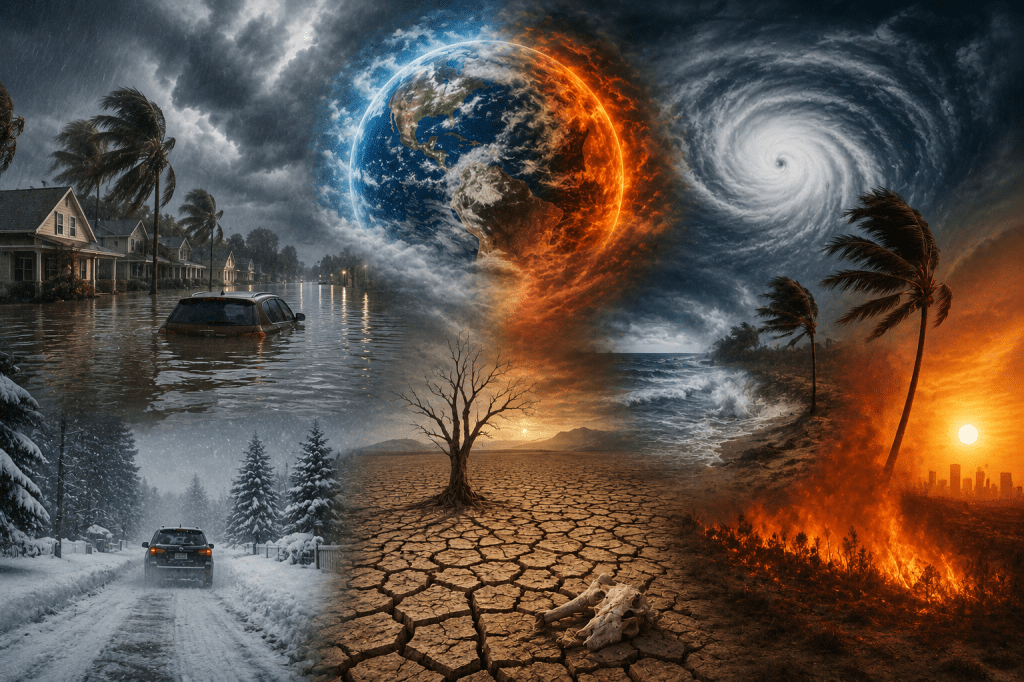
When I was a kid, the weather had the decency to follow some basic rules.
Summer was hot.
Winter was cold.
Spring was wet.
Autumn involved leaves falling off trees and your father announcing, for the sixteenth year in a row, that this would be the year he finally raked them properly.
Everyone understood the arrangement.
Now?
The weather appears to have suffered a complete psychological collapse.
One week it’s 75 degrees in February.
The next week your driveway looks like a scene from Antarctica.
Then it floods.
Then it dries up.
Then a hurricane arrives.
Then somebody on television explains that this is all because of something called El Niño.
Or La Niña.
Or possibly La Nada, which apparently is a real thing and sounds less like a climate pattern and more like a Mexican restaurant that went bankrupt.
The basic idea is this.
Every few years, the Pacific Ocean decides it’s bored.
Sometimes it warms up.
That’s El Niño.
Sometimes it cools down.
That’s La Niña.
And because the atmosphere apparently enjoys chaos, these changes end up affecting weather all over the planet, bringing floods, droughts, heat waves, snowstorms, and changes in hurricane activity.
It’s astonishing.
A patch of ocean decides to have feelings and suddenly people in another hemisphere are buying sandbags.
Scientists have spent decades studying these climate patterns.
They know El Niño can influence droughts, floods, wildfires, and global temperatures.
They know La Niña often strengthens Atlantic hurricane activity and can contribute to extreme rainfall and flooding in some places while drying out others.
What they don’t know is why your barbecue is guaranteed to coincide with the only thunderstorm of the month.
Some mysteries remain beyond science.
Of course, El Niño and La Niña aren’t the whole story.
Because hovering over all of this like a giant elephant wearing a Hawaiian shirt is climate change.
Now here’s where things become amusing.
Or depressing.
Possibly both.
When our parents were young, records were broken occasionally.
Now they seem to be broken every fifteen minutes.
Heat records.
Rainfall records.
Ocean temperature records.
Wildfire records.
Flood records.
At this point, if a weather forecaster announces that something is the hottest, wettest, driest, windiest, or most expensive event ever recorded, nobody even looks up from their sandwich.
We’ve become numb to it.
Another “once-in-a-century” flood arrives every six years.
A “historic” heatwave happens three times before Labor Day.
A winter storm dumps three feet of snow somewhere that normally receives three inches.
Meanwhile another place that used to be buried under snow all winter is mowing its lawn in January.
Scientists aren’t saying climate change creates El Niño or La Niña.
What they’re saying is that these natural climate swings are now occurring in a warmer world, which can make the consequences more severe. Wetter places can get wetter. Hot places can get hotter. Floods and droughts can become more extreme.
Which brings us to Florida.
Ah yes.
Florida.
The state where people build houses directly beside the ocean and then act surprised when the ocean arrives for a visit.
Florida is wonderful.
I love Florida.
But nowhere on Earth has a more entertaining relationship with climate change.
A hurricane removes half a neighborhood.
The ocean creeps farther inland.
Insurance companies flee the state at speeds normally associated with military retreats.
The summer heat becomes capable of cooking a medium-rare steak on a mailbox.
And still somebody appears on television to explain that climate change is a hoax.
At this point, denying climate change is a bit like standing knee-deep in floodwater while insisting the swimming pool isn’t leaking.
The evidence is no longer subtle.
You can argue about causes.
You can argue about solutions.
You can argue about costs.
Reasonable people do that all the time.
But arguing that nothing unusual is happening requires a level of commitment normally seen only in cult leaders and people who still believe their ex is coming back.
Which leaves two possibilities.
Either some climate deniers are genuinely convinced nothing is happening despite mountains of evidence to the contrary.
Or—and this possibility should concern everyone—they understand perfectly well what’s happening but have discovered that acknowledging it might interfere with profits, politics, influence, or power.
Neither explanation is particularly comforting.
One involves denial.
The other involves calculation.
Pick your favorite.
The truly maddening part is that this shouldn’t even be political.
The weather doesn’t care who you voted for.
A flood doesn’t stop halfway down the street because it encountered a campaign sign.
A hurricane doesn’t check party registration before removing your roof.
Nature remains gloriously indifferent to human arguments.
Which is why the smartest farmers, fishermen, and outdoorsmen I know don’t spend much time debating whether the weather is changing.
They’re too busy noticing that it has.
They see it in planting seasons.
Fishing seasons.
Water levels.
Heat.
Rainfall.
Storm intensity.
People who work outside tend to become experts because nature grades every exam immediately.
Get it wrong and your crop dies.
Or your boat sinks.
Or your barn ends up in another county.
The rest of us have the luxury of arguing about it on social media.
Still, there is a strange comfort in all this chaos.
Because despite everything, humanity remains wonderfully adaptable.
We’ve survived ice ages.
Droughts.
Floods.
Volcanoes.
Plagues.
And several decades of reality television.
We’ll survive this too.
But first we’d better stop pretending that the weather hasn’t gone completely mad.
Because it has.
Winter can’t decide whether it’s February or April.
Summer now arrives angry.
Hurricanes seem to have discovered performance-enhancing drugs.
Floods appear where droughts used to be.
Droughts appear where floods used to be.
And the Pacific Ocean keeps flipping between El Niño and La Niña like a drunk man searching for the correct light switch.
The weather of our childhood is becoming a memory.
The weather our parents knew is disappearing even faster.
And whether you blame El Niño, La Niña, climate change, or all three together, one thing is undeniable.
The atmosphere has stopped reading the instruction manual.
And frankly, it shows.
Thanks for dropping by my little corner of the world. If the story gave you a chuckle or made you pause and think, a like would be mighty kind. And if you’re feeling adventurous, well, hitting that subscribe button is like pulling up a chair and staying a while—always room for one more.
I subscribe back, by the way. It’s my way of saying, “Welcome to the club—snacks are in the back, good times up front!”
Your comments make me smile, sometimes laugh out loud, and every now and then, they nudge me to dig a little deeper, write a little better. So, stick around—who knows what we’ll stumble upon next!
My book, Hidden Alignment is still available on Amazon in paperback and Kindle for those interested. Link and QR code below.
Link: https://a.co/d/0enjFI6f



 A Kings
Leave a comment