By a man who survived dial-up’s screeching apocalypse and still insists the internet is a polite butler—not a life-support system.
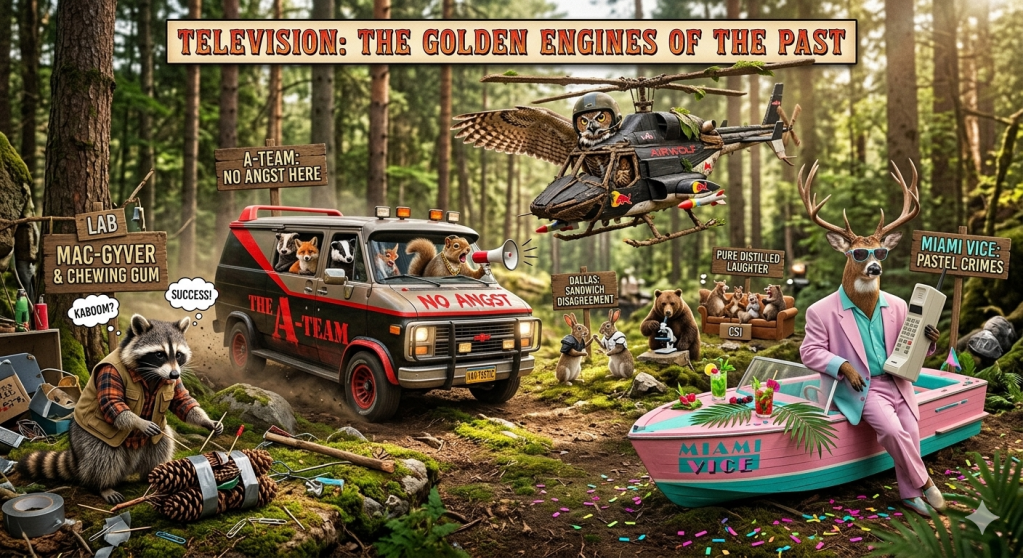
Back in the 1980s and 1990s, TV shows were like cars before the electric resurgence—loud, unashamed, and occasionally on fire, but in a thrilling way. You had MacGyver, a man who could fix anything with chewing gum, paperclips, and sheer disdain for physics. Today, if a character tries that, Netflix adds a “disclaimer: do not attempt”—as if a 12-year-old wasn’t already trying to make a jetpack out of duct tape and sadness.
Then there was The A-Team, where a bunch of grown men drove around in a van painted like a circus accident, shooting guns, exploding things, and still somehow being polite to civilians. Nobody asked for “character development” or “plot realism.” It was chaos, and chaos was beautiful. Imagine showing that to a writer today: “No, we need angst over a coffee cup spilling.”
Airwolf had a helicopter that could fly like it was on Red Bull steroids. And yes, it shot missiles. And yes, it was cooler than your entire existence. Today, if a show has a helicopter, it’s probably filming someone awkwardly walking to a coffee shop, lamenting their feelings.
And let’s not forget the glamorous chaos of Miami Vice, where everyone looked like they just stepped out of a fashion magazine and somehow solved crimes between sipping neon-colored cocktails. Or Dallas, where oil, betrayal, and shoulder pads collided in a tornado of melodrama that made Game of Thrones look like a mild disagreement over a sandwich.
CSI brought the 2000s into our living rooms with flashy microscopes, cool crime scenes, and a level of forensics that made every viewer believe they could solve murder with a cotton swab and an attitude. Meanwhile, comedies like Friends or Seinfeld gave us jokes that landed like a punch to the funny bone—no brooding, no slow-camera artistic angst, just pure, distilled laughter.
The Fresh Prince of Bel-Air before the “slap heard ‘round the internet” was pure joy, a mix of charm, ridiculous outfits, and Will Smith being impossibly cool. Nobody paused to ask, “But what’s the underlying trauma?” They laughed, they loved, they learned how to breakdance without suing anyone. The Cosby Show (pre-scandal) was wholesome, clever, and funny—like a sitcom that actually made families want to sit together without groaning about their phones.
And here’s the thing: no political correctness, no social experimentation on what should or shouldn’t be “normal.” You didn’t need a committee to tell you if a joke was acceptable or a plotline woke enough. It was relaxing. Honest. Raw. You could watch a raccoon driving a van, an owl flying a missile helicopter, and a fox in pastel Miami Vice threads, and nobody would lecture you on microaggressions. You just laughed. You felt clever. And occasionally, you learned something useful—like how to fix your toaster with a paperclip or solve a crime with nothing but a magnifying glass and a smug grin.
Contrast that with today’s TV, which is mostly dark, broody, and slow, like a diesel engine limping through a puddle of its own ambition. Everything has a “twist” or a “moral gray area.” You watch an episode and feel emotionally drained, like you’ve been forced to listen to a philosophy lecture while wearing wet socks.
Back then, shows were simple: explosions, punchlines, helicopters, clever gadgets, neon suits, oil barons, and occasional wholesome moral lessons that didn’t involve existential dread. You watched because it was fun. Today, if it’s fun, it gets canceled in three episodes because it “doesn’t explore contemporary societal conflicts with nuance.” Translate that into driving-speak: it’s like buying a car that won’t start because the engine “feels insecure.”
In short, TV from the 80s, 90s, and early 2000s was the sports car of entertainment—loud, fast, occasionally absurd, and entirely unapologetic. Today’s TV? A Tesla stuck in traffic, politely apologizing for existing. And honestly, I’d rather strap myself to a MacGyver bomb-defusing sequence than watch one more 10-episode series about people staring meaningfully at a brick wall.
Thanks for dropping by my little corner of the world. If the story gave you a chuckle or made you pause and think, a like would be mighty kind. And if you’re feeling adventurous, well, hitting that subscribe button is like pulling up a chair and staying a while—always room for one more.
I subscribe back, by the way. It’s my way of saying, “Welcome to the club—snacks are in the back, good times up front!”
Your comments make me smile, sometimes laugh out loud, and every now and then, they nudge me to dig a little deeper, write a little better. So, stick around—who knows what we’ll stumble upon next!
If you’re feeling a little generous—like the world’s got just enough warmth left in it for a small kindness—wander on over to my Donate page. No pressure, just a gentle nudge from the universe, saying, “Hey… this might be worth it.”


 A Kings
Leave a comment